The Scripture Mission
1. Tathāgata Sends Guanyin East
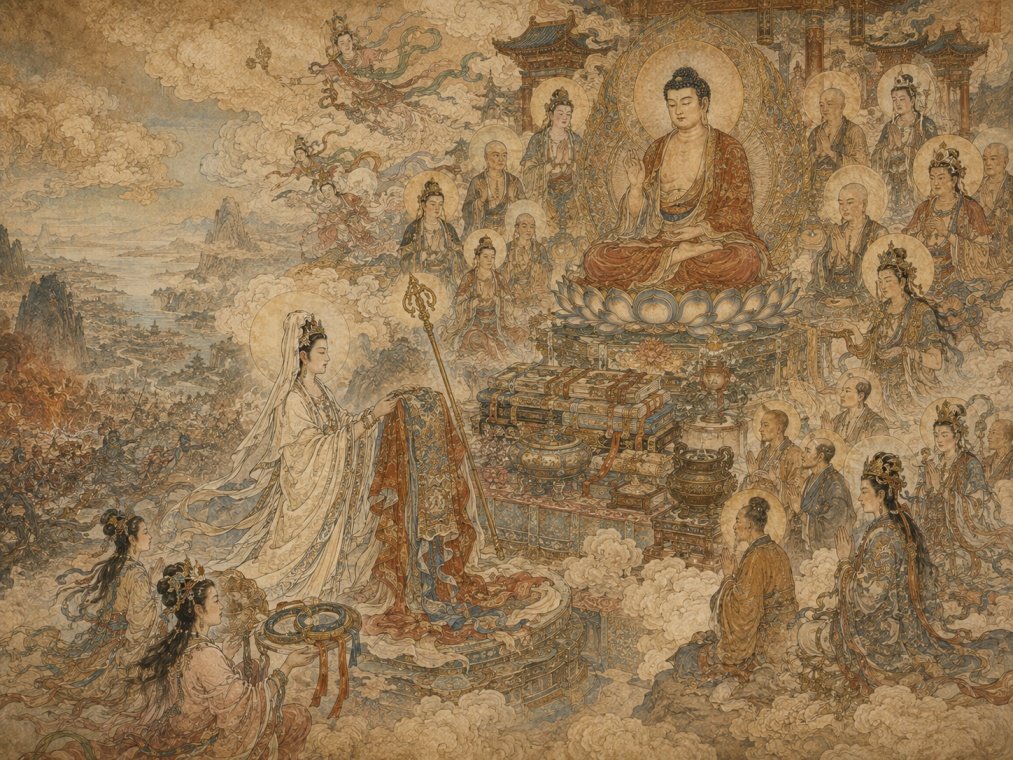
About five hundred years after Wukong is imprisoned, Tathāgata gathers the buddhas, arhats, bodhisattvas, and other holy beings at Spirit Mountain.
He explains that the people of the four continents differ greatly in conduct. Of particular concern is South Jambūdvīpa, where people are troubled by violence, deception, slander, and wrongdoing.
Tathāgata possesses three collections of true scriptures—vinaya, śāstras, and sūtras—containing thirty-five divisions and 15,144 scrolls. These teachings can guide people toward virtue and salvation.
Rather than simply sending the scriptures east, however, Tathāgata declares that a virtuous believer must make the difficult journey from the East to Spirit Mountain and personally seek them.
Guanyin volunteers to travel east and find this scripture pilgrim.
Tathāgata gives her an embroidered cassock, a nine-ring priestly staff, and three magical fillets with their corresponding spells. The cassock and staff are intended for the pilgrim; the fillets may be used to discipline powerful supernatural beings who become his disciples.
2. Sha Wujing and Zhu Wuneng Await the Pilgrim
Guanyin travels east with Hui’an while carefully observing the route the future pilgrim must follow.
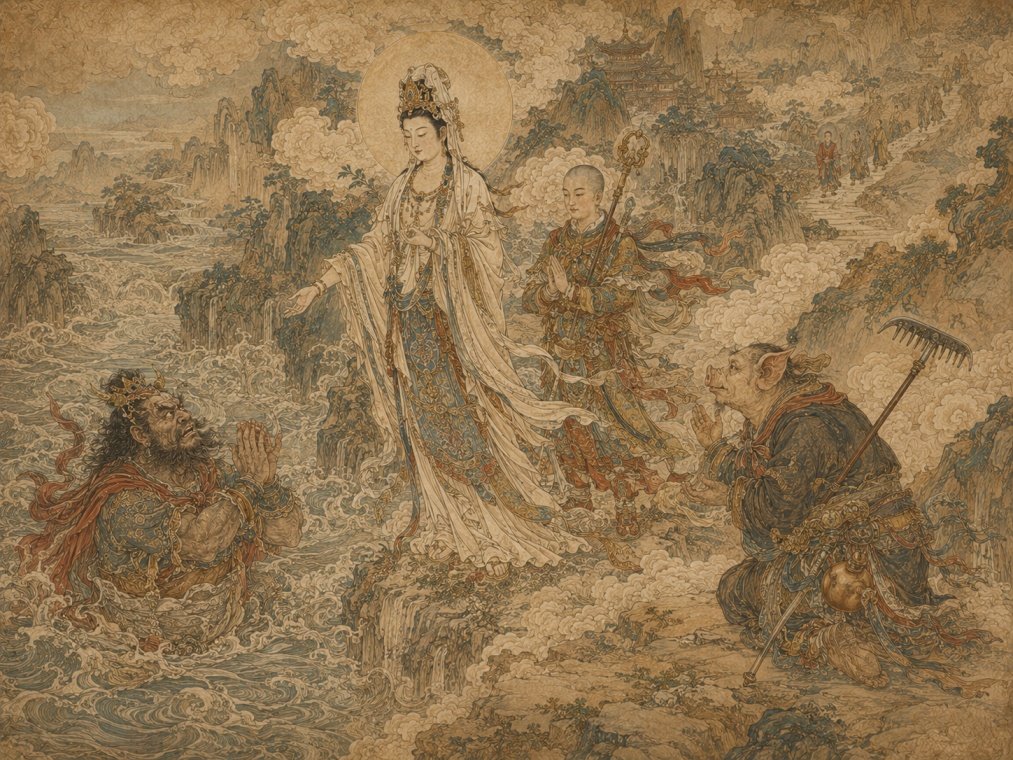
At the Flowing Sand River, a fierce monster attacks them. After fighting Hui’an, he reveals that he was once the Curtain-Raising General of Heaven. Banished after breaking a crystal cup, he has been suffering in the mortal world and devouring travelers.
Guanyin offers him redemption if he will wait for the scripture pilgrim and become his disciple. She gives him the surname Sha and the religious name Wujing.
Further east they encounter another monster armed with a nine-toothed rake. He explains that he was formerly the Marshal of the Heavenly Reeds, but after offending Heaven he was reborn through a sow and became a man-eating creature.
Guanyin again offers a path to redemption. She names him Zhu Wuneng and instructs him to abandon killing, live on a vegetarian diet, and wait for the scripture pilgrim.
Two future members of the pilgrimage are now in place.
3. The White Dragon and Sun Wukong Receive Their Chance
Guanyin next encounters a young dragon suspended in the sky awaiting execution.
He is the son of Aorun, Dragon King of the Western Ocean. After accidentally setting fire to the palace and destroying precious pearls, he was condemned by the Jade Emperor.
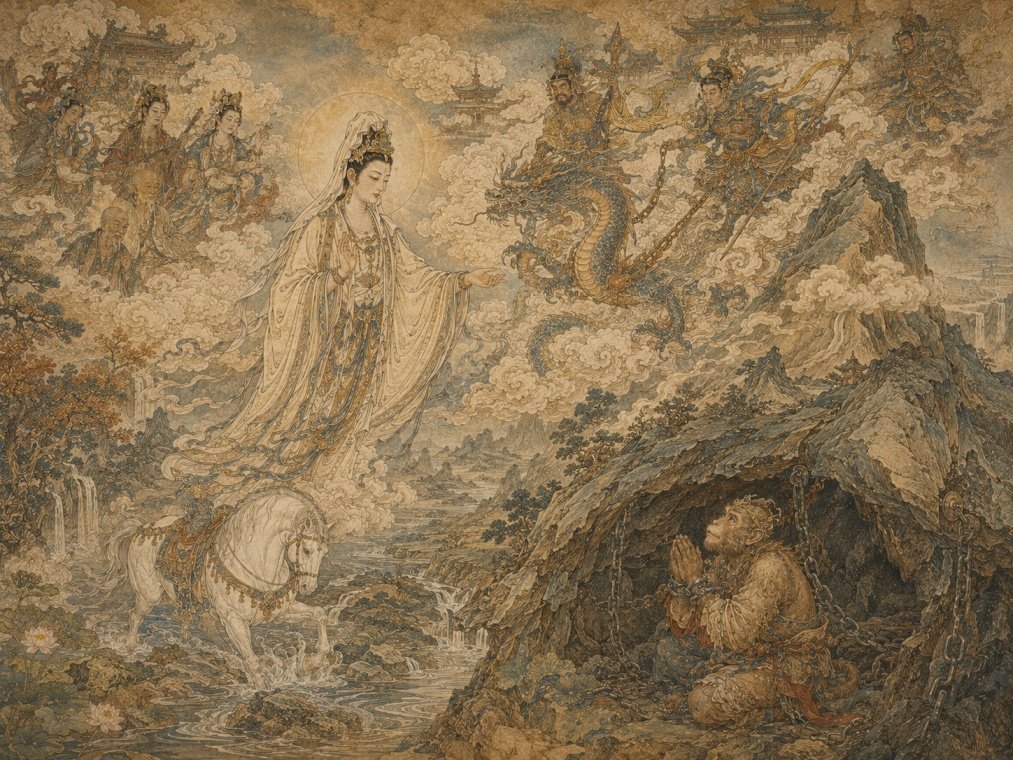
Guanyin personally petitions Heaven for his life. The Jade Emperor grants the pardon, and she orders the dragon to hide in a mountain stream. When the scripture pilgrim arrives, he is to transform into a white horse and carry him westward.
Continuing east, Guanyin reaches the Mountain of Five Phases, where Sun Wukong has remained imprisoned for more than five hundred years.
Wukong begs her to release him. Guanyin refuses to free him immediately but tells him that if he truly repents, a scripture pilgrim will eventually pass this way.
Wukong promises to reform and follow the pilgrim as a disciple.
Guanyin is pleased to discover that his existing religious name, Sun Wukong, already matches the “Wu” naming pattern of Wuneng and Wujing.
She then continues toward Chang’an in search of their future master.
4. The Birth of Xuanzang
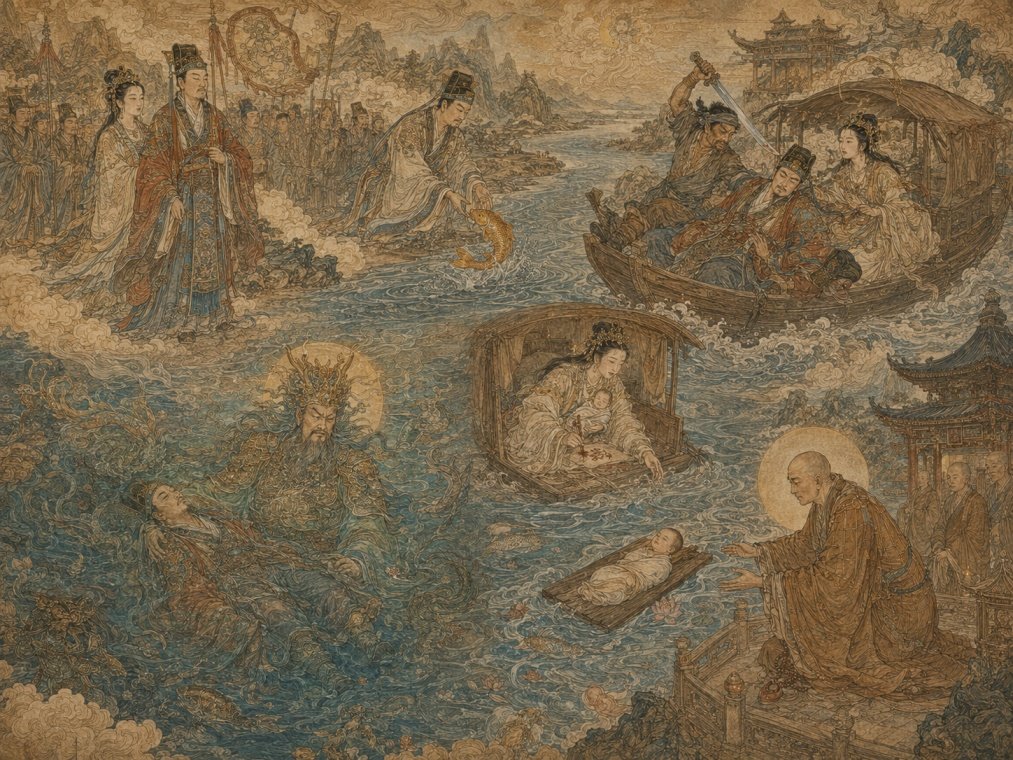
In Chang’an, the scholar Chen Guangrui wins first place in the imperial examinations and is appointed governor of Jiangzhou. He marries Wenjiao, daughter of Chief Minister Yin Kaishan, and begins travelling to his new post.
Along the way, Guangrui purchases a golden carp but releases it after sensing that it is no ordinary fish.
Later, while crossing the Hong River, the boatman Liu Hong murders Guangrui, kills his servant, and seizes Wenjiao. Taking Guangrui’s official credentials, Liu Hong assumes his identity and travels to Jiangzhou.
Unknown to him, the released golden carp was actually the Dragon King of the Hong River. Grateful for Guangrui’s earlier kindness, the Dragon King preserves his body and keeps his soul safe.
Wenjiao, meanwhile, gives birth to a son. Fearing Liu Hong will kill the child, she writes the story of his birth in her own blood, marks him for future recognition, places him on a wooden plank, and sends him down the river.
The infant reaches Gold Mountain Temple, where Abbot Faming rescues and raises him.
He becomes known as River Float, and later receives the religious name Xuanzang.
5. Xuanzang Discovers His Family
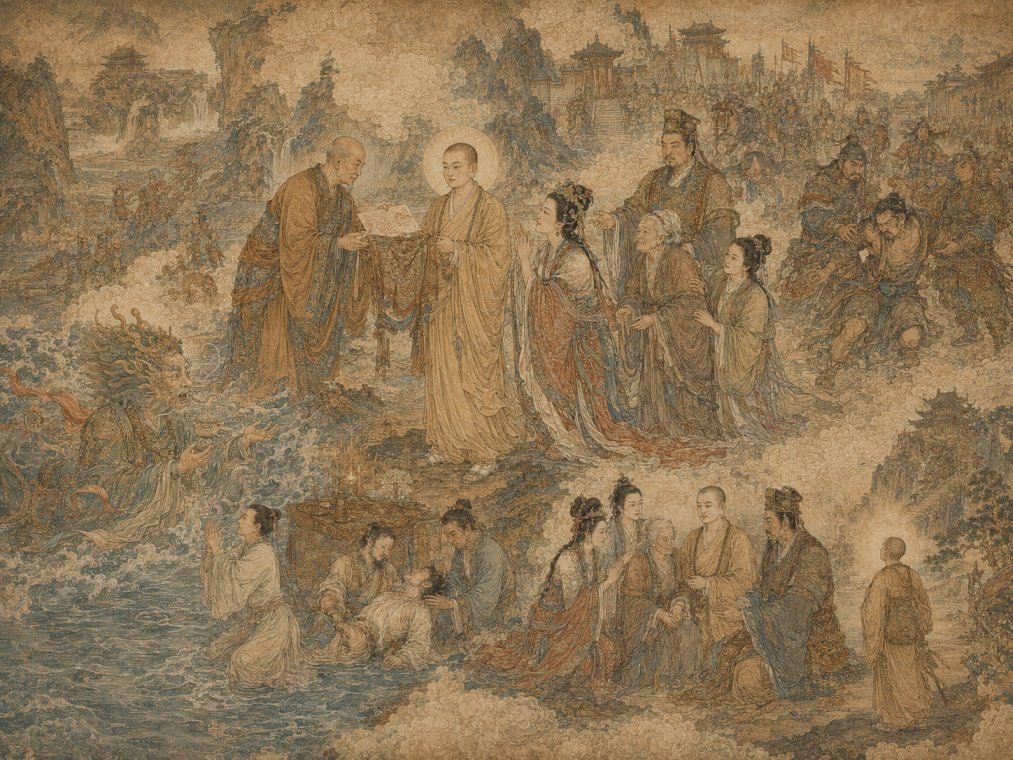
At eighteen, Xuanzang learns from Abbot Faming that he was not abandoned without reason.
The abbot gives him the blood-written letter and garment that had accompanied him as an infant. Xuanzang finally discovers the identities of his parents and the crime committed against them.
He travels to Jiangzhou and secretly meets his mother, Wenjiao. The letter and the missing toe marked at birth confirm that he is truly her son.
Following her instructions, Xuanzang finds his blind grandmother and later goes to Chang’an to meet his maternal grandfather, Chief Minister Yin Kaishan.
The chief minister informs Emperor Taizong and leads imperial troops to Jiangzhou. Liu Hong and his accomplice are captured and punished.
At the Hong River, the family performs rites for the murdered Guangrui. Hearing their prayers, the Dragon King restores Guangrui’s soul to his preserved body.
Guangrui returns to life and the separated family is reunited.
Xuanzang nevertheless chooses the religious path rather than worldly advancement, continuing his Buddhist cultivation as a monk.
6. The Jing River Dragon Defies Heaven
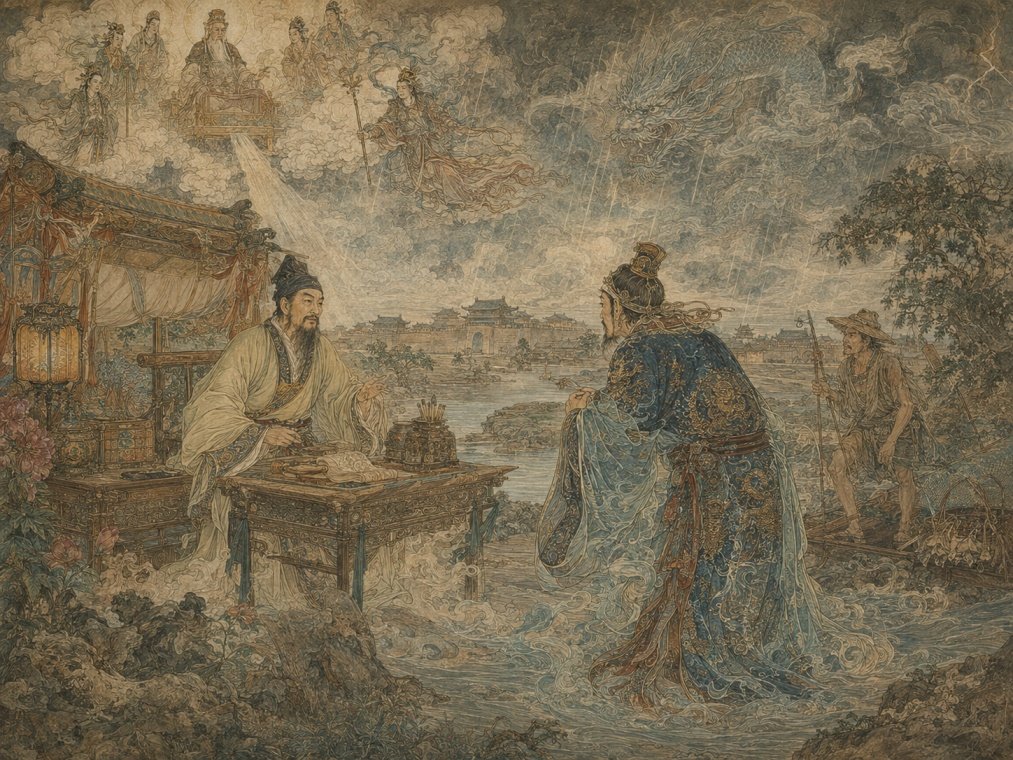
Near Chang’an, fisherman Zhang Shao reveals that a fortune-teller named Yuan Shoucheng tells him exactly where to fish each day.
The Jing River Dragon King fears that such predictions will eventually destroy the creatures of his river.
Disguised as a scholar, he visits Yuan Shoucheng and challenges him to predict the next rainfall.
The fortune-teller gives the exact times at which clouds, thunder, rain, and its final cessation will occur, along with the precise quantity of rain.
Soon afterward, the Jade Emperor issues the Dragon King an order containing exactly the same instructions.
Unwilling to lose his wager, the Dragon deliberately changes both the timing and quantity of rainfall.
He then returns triumphantly to Yuan Shoucheng, only to discover that the fortune-teller knows exactly what he has done.
By altering Heaven’s command, the Dragon King has committed a capital offense.
Yuan tells him that he will be executed the following day by the human judge Wei Zheng.
Terrified, the Dragon decides to seek help from Emperor Taizong.
7. Wei Zheng Executes the Dragon
The Jing River Dragon appears in Emperor Taizong’s dream and begs him for protection.
Because Wei Zheng is the appointed executioner, Taizong promises to save the Dragon by preventing Wei from carrying out the sentence.
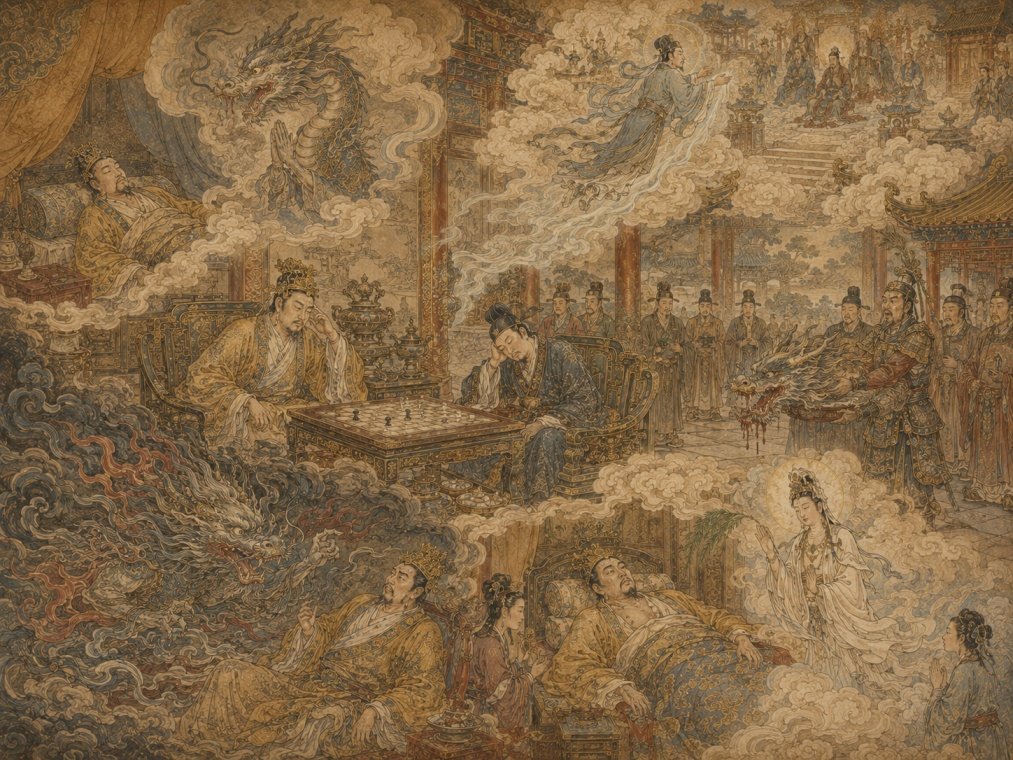
The next day, the emperor summons Wei Zheng and deliberately keeps him at court. As the appointed execution time approaches, Taizong begins a game of chess with him.
During the game, Wei Zheng unexpectedly falls asleep.
Taizong assumes his plan has succeeded.
Soon afterward, however, officials arrive carrying the severed head of a dragon that has fallen from the sky.
Wei Zheng explains that while his body slept beside the emperor, his spirit travelled to Heaven and carried out the Jade Emperor’s command. The Jing River Dragon has been executed.
That night, the Dragon’s angry ghost returns to Taizong, accusing him of breaking his promise and demanding that the matter be judged in the Underworld.
Guanyin drives the ghost away, but Taizong becomes seriously ill.
Despite guards and protective measures around the palace, his condition worsens until he finally dies, carrying with him a letter from Wei Zheng addressed to Judge Cui of the Underworld.
8. Taizong's Journey through the Underworld
Taizong’s soul enters the Region of Darkness and meets Judge Cui Jue, an old associate of Wei Zheng.
The Ten Kings of the Underworld review the Jing River Dragon’s accusation and determine that the Dragon had already been destined to die by the hand of a human judge.
Judge Cui secretly alters Taizong’s life record, changing his allotted lifespan so that he still has twenty years remaining.
The emperor is therefore permitted to return to life.
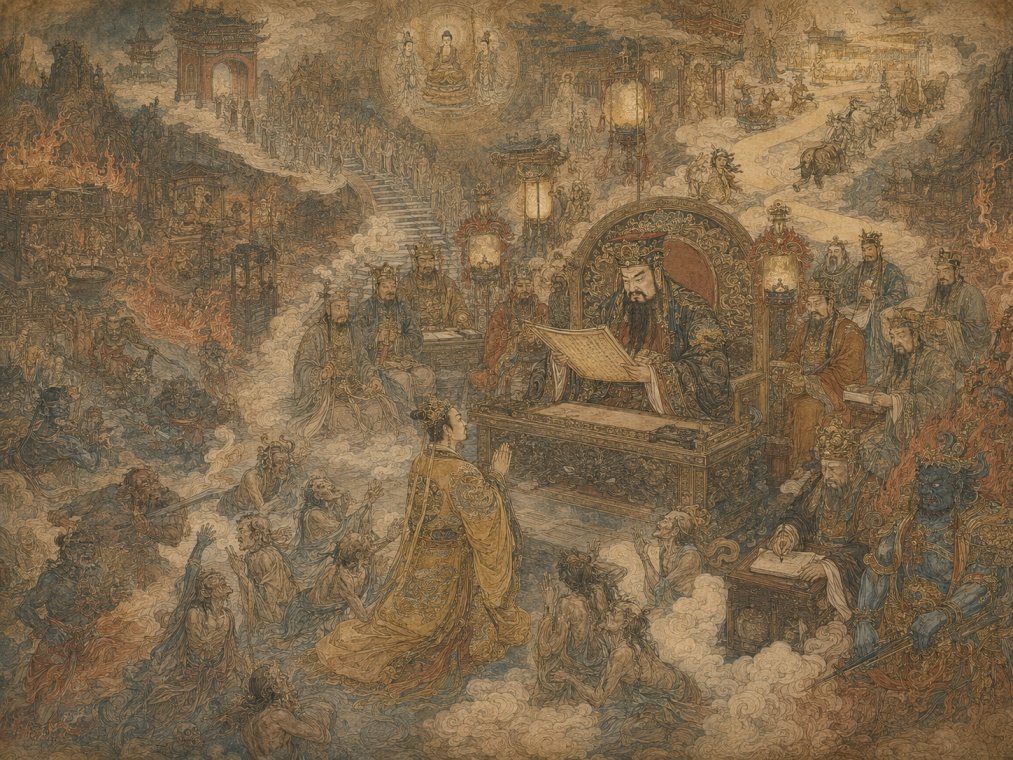
Before leaving, however, Taizong is led through the terrifying regions of Hell. He sees punishments for murder, dishonesty, exploitation, violence, disloyalty, and other wrongdoing.
At the City of the Dead, countless neglected spirits surround him demanding repayment for lives lost. Taizong borrows wealth from the accumulated merit of a virtuous man named Xiang Liang so the spirits can be appeased.
He promises to hold a Grand Mass of Land and Water after returning to the living world, so that abandoned souls may receive salvation.
After passing the Sixfold Path of Transmigration, Taizong is sent back to the mortal realm and awakens after being dead for three days and nights.
9. The Grand Mass and the Choice of Xuanzang
After returning to life, Taizong fulfills the promises made in the Underworld.
He sends melons to the Ten Kings and attempts to repay the wealth borrowed from Xiang Liang. When the virtuous man refuses the money, the emperor uses it to establish religious buildings and support Buddhist services.
Taizong then orders monks from across the empire to gather in Chang’an for the Grand Mass of Land and Water, intended to save the abandoned spirits he encountered below.
Among the assembled monks, officials must choose someone of exceptional merit to lead the ceremonies.
They select Chen Xuanzang.
The choice is especially significant because Xuanzang is identified as the earthly incarnation of Gold Cicada, a former disciple of Tathāgata.
Xuanzang is appointed Grand Expositor of the Faith and placed in charge of the great religious assembly.
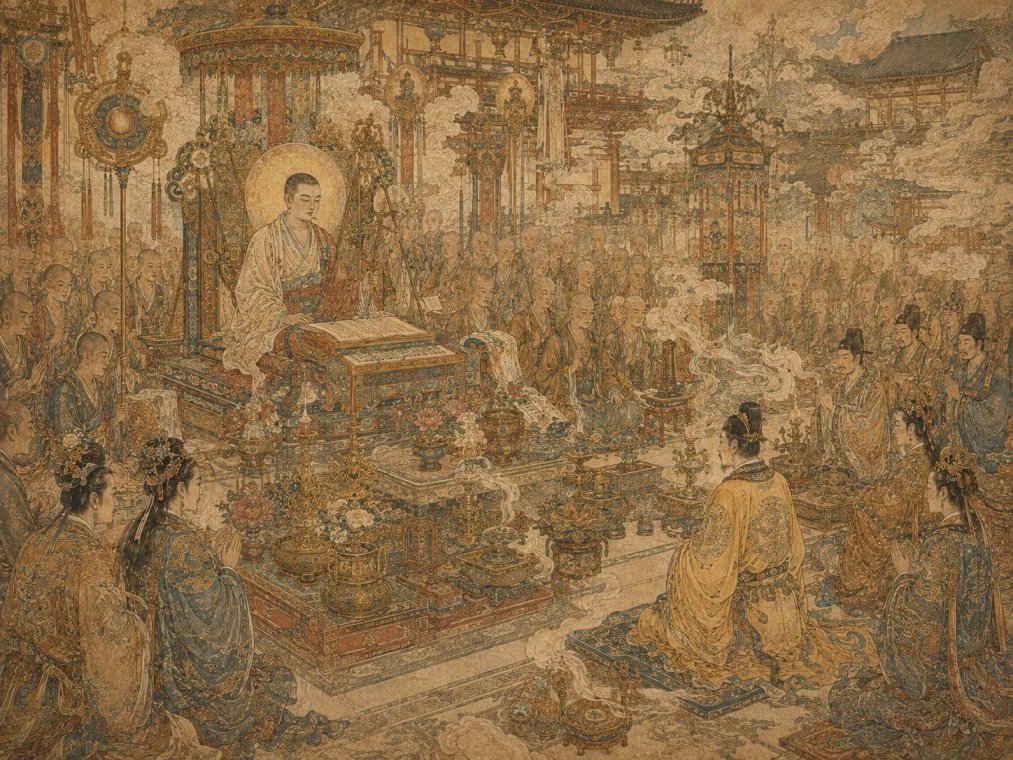
A total of 1,200 monks gather at the Temple of Transformation. The Mass is planned to last forty-nine days.
Xuanzang presides over the ceremonies while Emperor Taizong and his court attend to burn incense, hear the scriptures, and seek the salvation of the dead.
10. Tripitaka Begins the Journey West
Guanyin recognizes Xuanzang as the scripture pilgrim she has been seeking.
Still disguised, she brings the embroidered cassock and nine-ring staff into Chang’an. Emperor Taizong eventually receives these treasures and presents them to Xuanzang.
During the Grand Mass, Guanyin interrupts Xuanzang’s teaching and declares that the scriptures being preached belong only to the Little Vehicle.
She reveals that the true Great Vehicle Tripitaka lies at Tathāgata’s Thunderclap Monastery in the Western Heaven and can bring far greater salvation.
Guanyin then reveals her divine form before the emperor and assembled population.
Taizong immediately asks who will undertake the journey west.
Xuanzang volunteers.
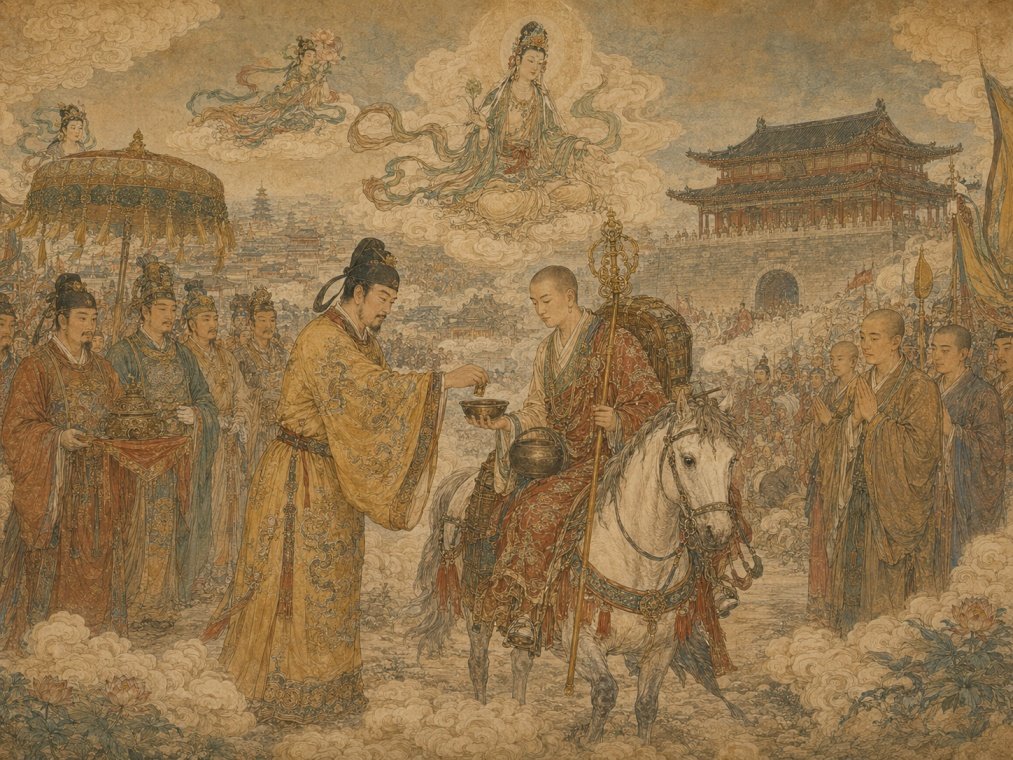
Moved by his loyalty and courage, the emperor becomes his sworn brother and commissions him to obtain the scriptures. Because he seeks the three collections, Taizong gives him the byname Tripitaka.
On an auspicious day, Xuanzang receives his travel rescript, attendants, horse, alms bowl, and supplies.
Outside Chang’an, Taizong personally sees him off and places a handful of homeland soil into his cup—a reminder that his native land is worth more than foreign riches.
Tripitaka then rides west, beginning the great pilgrimage.